You are ready to purchase a home. You may have spent months researching neighborhoods, reviewing your finances, and preparing for one of the largest financial commitments of your life. Now comes one of the most important decisions: selecting the right mortgage.
In the competitive mortgage market of 2026, even a small difference in interest rates or fees can significantly affect the total amount you pay over the life of your loan. Instead of accepting the first mortgage offer you receive, it makes sense to compare multiple financing options and understand the complete cost of borrowing.
Conventional and FHA mortgages commonly require buyers to make a down payment, which can create a major obstacle for households with limited savings. For buyers purchasing homes in eligible rural and suburban communities, however, USDA mortgage loans can provide an important alternative.
Backed by the U.S. Department of Agriculture, USDA home loans are designed to help eligible low- and moderate-income households purchase qualifying properties with no down payment. For buyers who meet the program requirements, this can substantially reduce the amount of cash needed upfront.
However, the interest rate is only one part of the equation. USDA loans have their own guarantee fees, income requirements, property eligibility rules, and underwriting standards. To understand the actual USDA mortgage loan cost, you need to examine all of these factors together.
The objective is not simply to find a mortgage with a low advertised rate. You should evaluate the complete cost of the loan, including the interest rate, upfront guarantee fee, annual fee, closing costs, and monthly payment.
USDA financing is generally available through two primary programs: the Guaranteed Loan Program and the Direct Loan Program. Each program serves a different group of borrowers and has different eligibility and pricing characteristics.
This guide explains how USDA mortgage loans work in 2026, how their fees compare with other mortgage options, who may qualify, and what you should consider before requesting a quote from a USDA-approved lender.
What Are USDA Mortgage Loans?
USDA mortgage loans are government-backed home financing programs designed to encourage homeownership in eligible rural and suburban communities throughout the United States.
The program is administered by the U.S. Department of Agriculture and is intended primarily for eligible households that meet specific income requirements. One of its most notable features is the ability to purchase an eligible home with 100% financing, meaning a traditional down payment may not be required.
Unlike conventional mortgages, most USDA Guaranteed Loans are not issued directly by the government. Instead, approved banks, credit unions, and mortgage lenders provide the financing while the USDA guarantees the loan.
That government guarantee reduces the lender’s risk and allows participating lenders to offer financing with features that can be attractive to qualified borrowers.
Two Main USDA Mortgage Programs
There are two primary USDA home loan programs you should understand:
1. USDA Guaranteed Loan Program
The Guaranteed Loan Program is the more commonly used USDA mortgage option.
Under this program, a private lender provides the mortgage while the USDA guarantees the loan. Borrowers generally need to meet USDA household-income requirements, and the property must be located in an eligible area.
A household can generally qualify with income up to 115% of the area’s median household income, although specific limits depend on location and household size.
The interest rate is determined by the lender and market conditions rather than being directly set by the USDA.
2. USDA Direct Loan Program
The USDA Direct Loan Program is designed for borrowers with very low or low incomes who cannot obtain reasonable financing through other sources.
In this program, the USDA provides the financing directly to eligible borrowers. Depending on the borrower’s circumstances, payment assistance may reduce the effective interest rate to as little as 1%.
The Direct Loan program has stricter income and eligibility requirements than the Guaranteed program, so applicants should verify their eligibility with USDA Rural Development.
Ultimately, your household income, financial situation, and the location of the property determine which USDA program may be available to you.
Key Features and Benefits of USDA Mortgage Loans
USDA financing has several characteristics that distinguish it from conventional and FHA mortgages.
Zero Down Payment
One of the biggest advantages of a USDA loan is the potential for 100% financing.
A conventional mortgage may require a down payment of 3% or more, while an FHA loan generally requires at least 3.5% for borrowers who meet the applicable credit requirements.
With an eligible USDA loan, you may be able to finance the entire purchase price without making a traditional down payment.
For example, on a $250,000 home, a 5% down payment would require $12,500 in cash. A USDA loan may allow that money to remain available for moving expenses, emergency savings, repairs, or other financial needs.
However, zero down does not mean you will necessarily need zero cash at closing. Closing costs and prepaid expenses can still apply.
Competitive Interest Rates
USDA loans can offer competitive mortgage rates because the government guarantee reduces some of the lender’s risk.
Your actual rate will depend on the lender, market conditions, loan characteristics, credit profile, and other underwriting factors.
For that reason, borrowers should request quotes from multiple USDA-approved lenders rather than assuming that every lender offers the same rate.
Even a modest rate difference can affect your monthly payment and the total interest paid over the life of the mortgage.
Flexible Qualification Guidelines
USDA financing can be useful for borrowers who do not have the credit profile required for the most competitive conventional mortgage products.
The USDA Guaranteed Loan program does not establish a single universal minimum credit score for every borrower. However, many lenders use a 640 credit score as an important benchmark for automated underwriting.
Applicants with lower scores may still qualify in certain circumstances, depending on the lender’s underwriting requirements and the strength of the overall application.
Lenders may also consider alternative credit information when traditional credit history is limited.
USDA Guarantee Fees
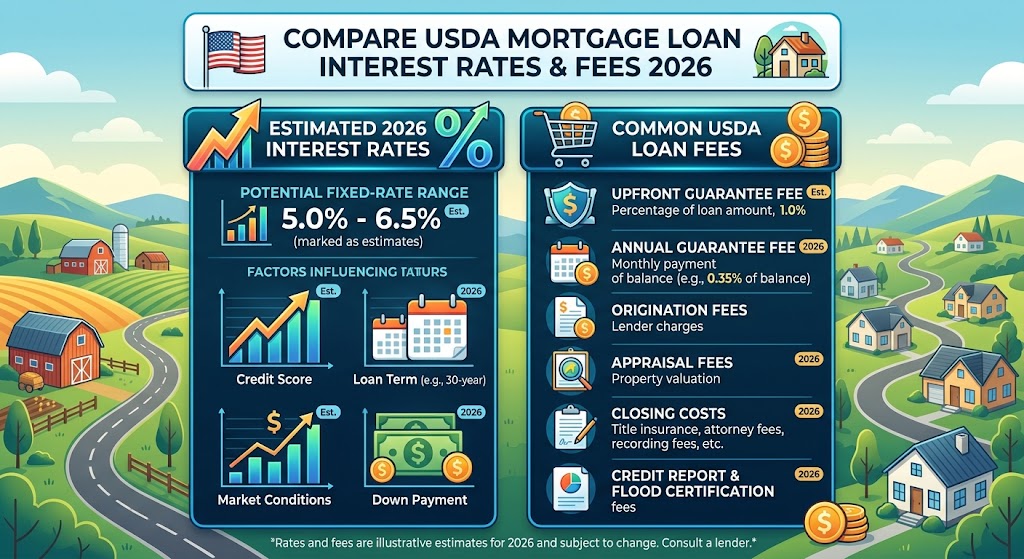
USDA loans do not use conventional Private Mortgage Insurance (PMI). Instead, the Guaranteed Loan program generally includes an upfront guarantee fee and an annual guarantee fee.
These fees help support the USDA loan guarantee program.
The upfront fee can generally be financed into the mortgage rather than being paid entirely from your own funds at closing.
The annual fee is incorporated into the borrower’s monthly mortgage payment.
USDA Mortgage Loan Pricing and Plans in 2026
To understand the true cost of a USDA mortgage, you need to look beyond the advertised interest rate.
The overall cost can include the mortgage interest, USDA guarantee fees, lender charges, appraisal expenses, title costs, taxes, insurance, and other closing expenses.
For the USDA Guaranteed Loan Program, two program-specific charges are particularly important.
1. Upfront Guarantee Fee
The upfront guarantee fee is a one-time charge associated with the USDA loan guarantee.
For 2026, the applicable fee should be verified through current USDA program guidance because USDA fees can change.
When permitted, the fee can generally be financed into the mortgage rather than paid completely in cash at closing.
For example, if a borrower purchases a home for $250,000 and finances an applicable upfront guarantee fee, the final loan amount may be higher than the home’s purchase price.
2. Annual Guarantee Fee
The annual guarantee fee functions similarly to mortgage insurance because it contributes to the cost of maintaining the USDA guarantee.
The fee is calculated according to the applicable USDA rules and is generally collected through the borrower’s monthly mortgage payment.
Because USDA fees can change from one fiscal year to another, borrowers should verify the current 2026 fee structure before finalizing their mortgage.
USDA Guaranteed vs. Direct Loans
The two USDA programs are designed for different types of borrowers.
| Loan Program | General Target Borrower | Down Payment | Interest Rate | Fees | Application |
|---|---|---|---|---|---|
| USDA Guaranteed Loan | Eligible low-to-moderate-income households | Potentially 0% | Set by participating lender | USDA guarantee fees may apply | Approved private lender |
| USDA Direct Loan | Very-low and low-income households meeting stricter requirements | Potentially 0% | USDA-established rate, with possible payment assistance | Different fee structure | USDA Rural Development |
The Guaranteed Loan is generally the more widely used option because applicants work with private mortgage lenders.
The Direct Loan program is more specialized and is intended for households with greater financial need.
Because program fees, rates, and income limits can change, you should verify the current requirements before applying.
Other USDA Mortgage Costs to Consider
A zero-down mortgage does not necessarily mean that the mortgage has no closing costs.
You may still encounter expenses such as:
- Lender origination charges
- Appraisal fees
- Credit report fees
- Title insurance
- Escrow charges
- Recording fees
- Homeowners insurance
- Property taxes
- Prepaid interest
- Other settlement expenses
Closing costs often vary significantly depending on the lender, location, purchase price, and transaction.
In some transactions, seller concessions may help cover eligible closing expenses, subject to USDA and transaction rules.
In certain circumstances, other financing structures may also help reduce the amount of cash required at closing.
The important point is to review your Loan Estimate carefully rather than focusing only on the mortgage rate.
7 Alternatives to USDA Mortgage Loans
USDA financing is not available to every buyer or every property. If you do not meet USDA requirements, several other mortgage options may be worth comparing.
1. FHA Loans
FHA mortgages are insured by the Federal Housing Administration and are widely used by buyers with smaller down payments.
Key Features
- Down payment can be as low as 3.5% for qualifying borrowers
- More flexible credit requirements than many conventional loans
- Available in urban, suburban, and rural locations
- Mortgage insurance premiums apply
FHA loans can be useful for buyers whose property is outside a USDA-eligible area.
However, borrowers should compare the total FHA mortgage insurance costs with the USDA guarantee fees and other loan expenses.
2. VA Loans
VA home loans are available to eligible veterans, active-duty service members, certain National Guard and Reserve members, and qualifying surviving spouses.
Key Features
- Potentially 0% down payment
- No monthly PMI
- VA funding fee may apply
- Eligibility depends on military service requirements
For borrowers who qualify, a VA loan provides a different cost structure from USDA financing.
Eligibility and the applicable funding fee should be confirmed before comparing offers.
3. Conventional Mortgages
Conventional mortgages are offered by private lenders and are not insured by the federal government in the same way as FHA or USDA loans.
Key Features
- Down payments can be relatively low
- No geographic USDA restrictions
- PMI may apply when the down payment is below certain thresholds
- PMI can generally be removed when applicable requirements are met
Conventional financing can be particularly attractive to borrowers with stronger credit and sufficient savings.
4. Conventional 97% Financing
Some conventional programs allow qualified borrowers to purchase a home with approximately 3% down.
These programs can provide an alternative for buyers who do not qualify for USDA financing but want to minimize their upfront payment.
Private mortgage insurance may apply until the borrower reaches the applicable equity requirements.
5. Down Payment Assistance Programs
State, county, city, and nonprofit organizations may offer down payment assistance (DPA).
Depending on the program, assistance can take the form of:
- Grants
- Forgivable loans
- Deferred-payment second mortgages
- Low-interest second mortgages
Eligibility varies widely by location, income, household size, property type, and first-time buyer status.
DPA programs can sometimes be combined with FHA or conventional mortgages.
6. Portfolio Mortgage Loans
Some banks and credit unions offer portfolio mortgages that they retain rather than selling into the secondary mortgage market.
These products may provide greater flexibility for certain borrowers, including people with unusual income structures or specific property circumstances.
However, rates, fees, underwriting rules, and down-payment requirements vary considerably between lenders.
7. Private Money and Hard Money Loans
Private money and hard money loans are generally designed for real estate investors rather than traditional owner-occupied homebuyers.
They may provide faster approval and flexible underwriting, but they often come with substantially higher interest rates and fees.
These loans are typically short-term and may be used by investors who purchase, renovate, and resell properties.
They are generally not comparable to USDA financing for a household seeking a long-term primary residence mortgage.
How to Choose the Right USDA Mortgage Loan
Selecting a mortgage should involve more than comparing advertised interest rates.
You should evaluate eligibility, total borrowing costs, monthly payments, lender fees, and the long-term financial impact.
1. Verify Property Eligibility
USDA financing is geographically restricted.
Before spending significant time on a property, check whether its address qualifies under the USDA’s current property eligibility rules.
A home that appears to be in a rural community is not automatically eligible.
Always verify the property’s status using current USDA resources.
2. Review Household Income
USDA eligibility is based partly on household income.
The applicable income limit depends on factors such as:
- Location
- Household size
- USDA program
- Eligible deductions
- Household income calculation rules
Do not assume that your qualifying income is simply the amount shown on your tax return or paycheck.
An approved lender or USDA representative can help determine how your household income is calculated.
3. Compare Total Mortgage Costs
Instead of comparing only interest rates, review:
- Interest rate
- APR
- Upfront USDA guarantee fee
- Annual guarantee fee
- Lender origination charges
- Closing costs
- Prepaid expenses
- Estimated monthly payment
- Total cash required at closing
This provides a more accurate picture of the cost of each financing option.
4. Request Multiple Quotes
Mortgage pricing varies between lenders.
Consider obtaining quotes from several USDA-approved lenders and ask each one for a detailed Loan Estimate.
When comparing lenders, look at the complete package rather than focusing exclusively on the advertised interest rate.
5. Get Pre-Approved
A pre-approval can help you understand how much you may be able to borrow before you begin making offers.
Your lender will generally review information such as:
- Income
- Employment
- Assets
- Debts
- Credit history
- Proposed property information
A USDA pre-approval can also help you move more efficiently when you find an eligible property.
USDA Mortgage Loans in 2026 and Beyond
The USDA mortgage program continues to play an important role in expanding homeownership opportunities in eligible communities.
However, borrowers should not assume that today’s rules will remain unchanged indefinitely.
USDA program details can change because of annual policy decisions, federal funding, housing-market conditions, and changes to eligibility requirements.
Potential Changes to Fees
USDA guarantee fees can be updated periodically.
Even a relatively small change can affect the total cost of a mortgage, particularly for borrowers who keep their loan for many years.
Before closing, confirm the current fee structure with your lender and review the official USDA requirements.
Income Limits Can Change
USDA income limits are not identical nationwide.
They vary by location and household size and can be updated periodically.
A household that qualifies in one county may not qualify under the same income threshold in another area.
Property Eligibility Can Change
USDA property eligibility maps can also change.
If a property is currently outside an eligible area, it is worth checking the current USDA map and requirements rather than relying on an outdated eligibility result.
Conclusion
USDA mortgage loans can provide an important financing option for eligible homebuyers who want to purchase a qualifying property without making a traditional down payment.
The biggest attraction is the potential for 100% financing, but the interest rate is only one part of the overall cost.
You should also evaluate the applicable USDA guarantee fees, lender charges, closing costs, property taxes, homeowners insurance, and monthly payment.
The USDA Guaranteed Loan and Direct Loan programs serve different borrowers, so determining which program applies to your financial situation is an essential first step.
If you are considering a USDA mortgage in 2026, compare offers from multiple approved lenders and request detailed Loan Estimates. Review the complete cost of each mortgage rather than choosing based solely on the advertised rate.
The right mortgage ultimately depends on your income, credit profile, savings, property location, financial goals, and eligibility for other programs such as FHA, VA, or conventional financing.
Frequently Asked Questions About USDA Mortgage Loans
Is a USDA loan worth considering?
A USDA loan can be worth considering if you meet the program’s income and property requirements and want to minimize your upfront cash requirement.
The potential 0% down-payment structure is one of its most important features.
However, you should compare the complete cost of the USDA mortgage with FHA, VA, and conventional alternatives before making a decision.
How much does a USDA mortgage cost per month?
Your monthly USDA mortgage payment can include several components:
- Principal
- Interest
- Property taxes
- Homeowners insurance
- USDA annual guarantee fee, when applicable
The exact payment depends on the loan amount, interest rate, property taxes, insurance costs, and applicable USDA fees.
Does a USDA mortgage have a free trial or demo?
No. A mortgage is a financial product and does not have a free trial.
However, you can speak with a USDA-approved lender to receive a mortgage quote, review estimated payments, and determine whether you may qualify.
A lender can also provide a Loan Estimate once you have submitted the necessary information.
Which USDA loan is appropriate for a household?
The USDA Guaranteed Loan is generally the program most homebuyers encounter because it is available through approved private lenders.
The USDA Direct Loan is intended for households with very low or low incomes that meet additional eligibility requirements.
Your income, household size, location, and financial circumstances determine which program you may qualify for.
What makes USDA loans different from other mortgages?
The most distinctive feature is the potential for zero down payment on an eligible purchase.
USDA loans also have specific income and geographic requirements and use guarantee fees rather than conventional PMI.
The overall cost should still be compared with other mortgage programs because a zero-down structure does not automatically mean the lowest total borrowing cost for every borrower.
Can you use a USDA mortgage outside a rural area?
USDA financing is restricted to properties that meet the program’s geographic eligibility requirements.
The term “rural” can be broader than many people expect, and some suburban communities may qualify.
You should check the specific property address using current USDA eligibility resources rather than judging eligibility based solely on how urban or rural the neighborhood appears.
What credit score is required for a USDA loan?
The USDA does not establish one universal minimum credit score that applies to every Guaranteed Loan borrower.
However, many lenders use a 640 FICO score as an important benchmark for automated underwriting.
Borrowers with lower scores may still be considered in certain situations, depending on the lender’s requirements and the strength of the overall application.
If your credit score is below 640, ask several USDA-approved lenders whether they will manually underwrite your application and what additional requirements may apply.