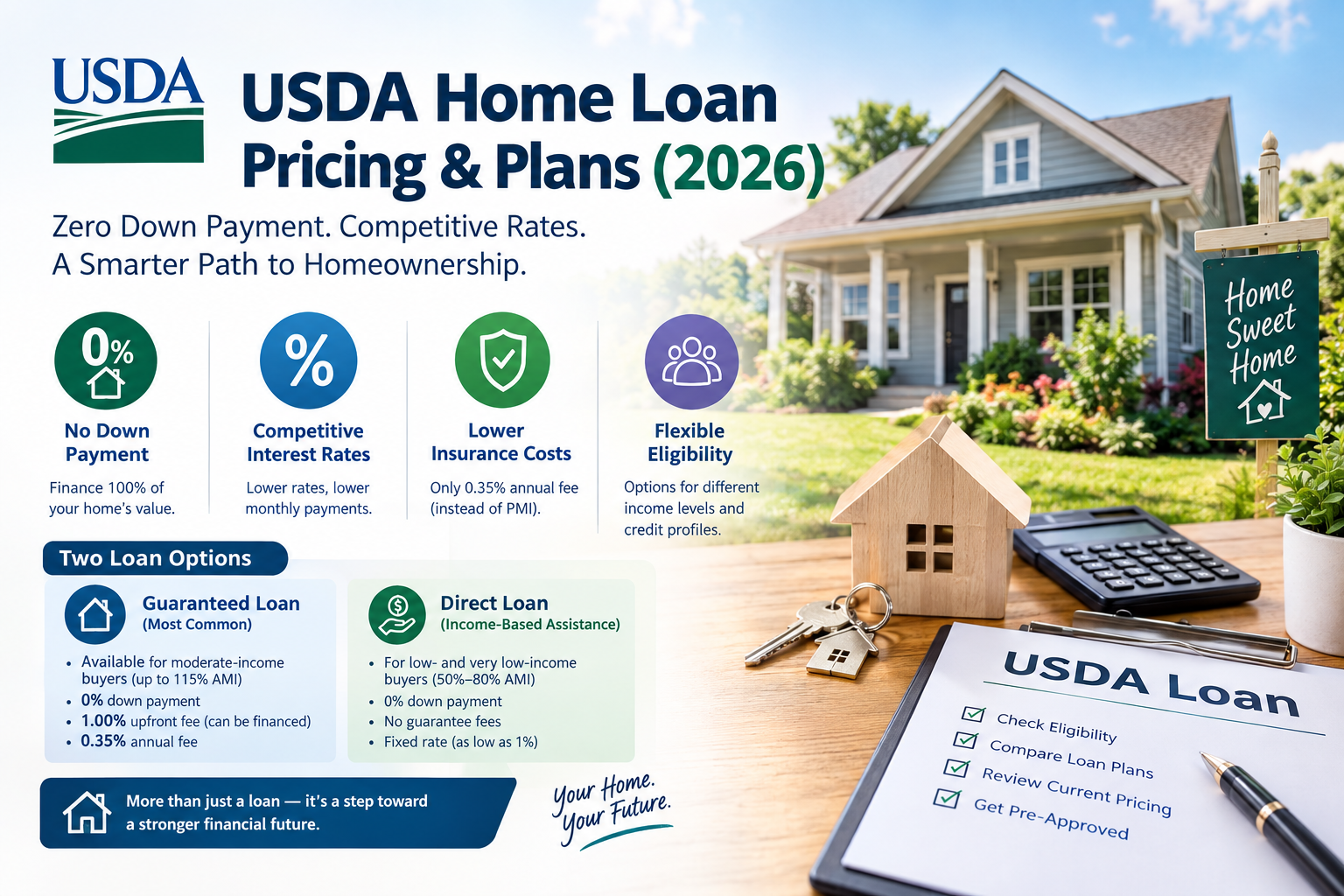
USDA Home Loan Pricing & Plans (2026)
You’re standing at a crucial point in your home-buying journey. In today’s 2026 market—where inventory remains limited and competition is intense—choosing the right financing isn’t optional; it’s essential. Even a small difference in interest rates can mean saving or spending tens of thousands of dollars over time. That’s why it’s critical to go beyond surface-level comparisons and fully evaluate every financing option available.
One of the biggest challenges buyers face is the upfront down payment. Traditional mortgages typically require between 3% and 20% of the home’s price in cash, which can be a major barrier. For buyers considering eligible rural or suburban areas, the USDA home loan offers a compelling, government-backed alternative that eliminates the need for a down payment entirely. It’s more than just a loan—it’s a strategic financial tool.
However, the appeal of “zero down” comes with its own structure. Instead of traditional private mortgage insurance (PMI), USDA loans include an upfront guarantee fee and an annual fee. This means you’re not just comparing interest rates—you need to calculate the total cost of the loan. Understanding USDA home loan pricing and plans in 2026 is key to determining your actual monthly payment.
Your goal is straightforward: secure the best zero-down financing option that improves your cash flow while helping you build equity efficiently. To do that, you must evaluate eligibility, compare the two main USDA loan options (Guaranteed vs. Direct), and choose the one that offers the best long-term value for your financial situation.
This guide focuses on what matters most—practical insights, current pricing strategies, and how to position yourself as a strong buyer using USDA financing.
What Is a USDA Home Loan?
A USDA home loan is a government-supported mortgage program designed to make homeownership more accessible in eligible rural areas. It provides 100% financing for low- to moderate-income buyers, with backing from the U.S. Department of Agriculture to promote economic growth and stability in rural communities.
Why It Matters: 100% Financing
The biggest advantage is simple: no down payment. You can purchase a home without the largest upfront expense, allowing you to preserve cash for closing costs, moving, or improvements. Instead of lending directly (in most cases), the USDA guarantees loans issued by approved lenders, reducing risk and enabling competitive interest rates.
The Two Main Loan Options
There are two primary USDA loan programs, and your income determines which one you qualify for:
- Guaranteed Loan Program (Most Common)
This option is provided through private lenders but backed by the USDA. It’s available to moderate-income buyers (up to 115% of the area’s median income). This is the most widely used USDA loan and offers competitive rates with zero down. - Direct Loan Program (Income-Based Assistance)
Here, the USDA acts as the lender. It’s intended for low- and very low-income borrowers (typically 50%–80% of median income). The major benefit is subsidized interest rates, which can be reduced significantly—sometimes as low as 1%.
For most buyers, the Guaranteed Loan is the primary option, while the Direct Loan provides exceptional benefits for those who qualify.
Key Benefits of a USDA Home Loan
When evaluating a mortgage, you should focus on both immediate savings and long-term financial impact. USDA loans offer several important advantages:
1. No Down Payment Required
You can finance 100% of the home’s value, eliminating one of the biggest barriers to homeownership.
2. Competitive Interest Rates
Because lenders receive a government guarantee, they can often offer lower or comparable rates to conventional loans.
3. Lower Insurance Costs
Instead of PMI, USDA loans use:
- Upfront Fee: 1.00% (can be rolled into the loan)
- Annual Fee: 0.35% (paid monthly)
These costs are typically lower than FHA or conventional loan insurance, reducing your monthly expenses.
4. Flexible Credit Requirements
While a 640 credit score is common for streamlined approval, borrowers with lower scores may still qualify through manual underwriting if they show strong financial stability.
USDA Loan Pricing Structure (2026)
Understanding the pricing model is essential to evaluating the total cost of the loan.
Guaranteed Loan Costs
- Down Payment: 0%
- Upfront Fee: 1.00% of loan (can be financed)
- Annual Fee: 0.35% of remaining balance (paid monthly)
For example, on a $300,000 loan:
- Upfront fee: $3,000 (added to loan)
- Annual fee: about $1,050/year (~$87/month initially)
These costs are often lower than FHA or conventional mortgage insurance.
Direct Loan Costs
- Down Payment: 0%
- Guarantee Fees: None
- Interest Rate: Fixed and potentially subsidized (as low as 1%)
This option offers the lowest cost but is limited to lower-income applicants.
Why Comparing Rates Still Matters
Even with USDA loans, your interest rate depends on the lender. To get the best deal, compare multiple offers and look at:
- Interest rate
- Lender fees
- APR (true cost of borrowing)
Shopping around is essential to secure the most favorable terms.
Alternatives to USDA Loans
If USDA isn’t the right fit, consider these options:
- VA Loan: 0% down, no PMI (for eligible military borrowers)
- FHA Loan: 3.5% down, easier credit requirements
- Conventional 97: 3% down, PMI can be removed later
- HomeReady/Home Possible: Low-income conventional options
- Portfolio Loans: Flexible underwriting from banks
- Jumbo Loans: For high-value properties
- Seller Financing / Land Contracts: Higher risk alternatives
- Hard Money Loans: Short-term, high-interest (for investors)
- Down Payment Assistance Programs: Grants or loans for upfront costs
- Assumable Mortgages: Take over an existing low-rate loan
Each option has its own cost structure, so comparing total expenses is key.
How to Choose the Right USDA Loan
To make the best decision:
- Check Eligibility
- Confirm property location qualifies
- Ensure your income meets program limits
- Compare Total Costs
- Look at monthly payments and upfront expenses
- Evaluate long-term affordability
- Work With the Right Lender
- Choose one experienced with USDA loans
- Get pre-approved to strengthen your offer
Outlook for USDA Loans Beyond 2026
The USDA loan program remains stable and widely supported due to its role in expanding homeownership. While fees may change slightly over time, the program is expected to continue offering strong benefits.
Additionally, technology improvements are helping speed up approvals, making USDA loans more competitive with conventional financing timelines.
Conclusion
The USDA home loan in 2026 continues to be one of the most attractive options for buyers in eligible areas. With zero down payment, competitive rates, and relatively low insurance costs, it provides a powerful path to homeownership.
To get the most value, focus on:
- Confirming eligibility
- Comparing lenders
- Understanding total loan costs
Taking these steps will help you secure the best possible financing and move forward with confidence.
FAQs
Is a USDA loan worth it?
Yes, especially if you want to avoid a down payment and keep monthly costs low.
What’s the monthly cost?
It includes principal, interest, taxes, insurance, and the 0.35% annual fee.
Is there a free trial or demo?
No, but lenders offer free consultations and pre-approvals.
Which plan is best?
Most buyers choose the Guaranteed Loan, unless they qualify for the Direct Loan.
Can I use it in a city?
No, only in eligible rural or suburban areas.
Do I need perfect credit?
No, many borrowers qualify with average credit and stable income.